Editorial Overview
As an independent tech review publication, we compare dehumidifiers using public DOE pint ratings, manufacturer wattage claims, and listed retail prices. During humid summer months when AC runs and windows stay closed, pint capacity matched to room size, honest noise at low fan, and daily kWh math predict satisfaction more reliably than vague “covers 4,500 sq ft” marketing.
Introduction: why dehumidifiers spike when AC season locks the windows
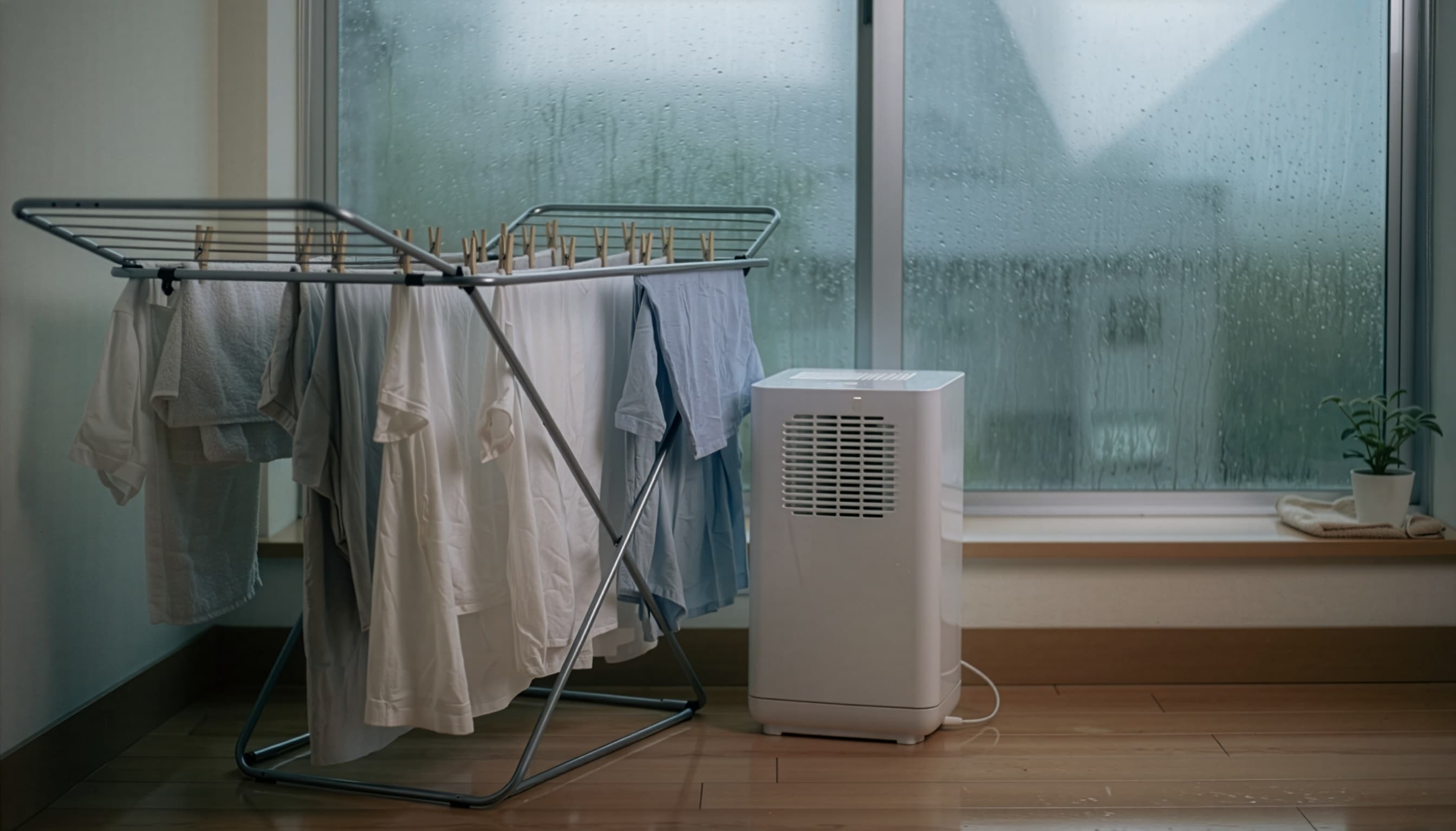
After a rainy weekend I opened the basement utility door and the musty bedding smell hit first — AC was on, yet the room still felt clammy. From the public spec sheet: many homes chase temperature and miss humidity.
Heat-season habits — closed windows, continuous cooling, school-break traffic — push indoor RH past comfort in basements, laundry rooms, and first-floor apartments. Undersized or short-cycling AC leaves clammy air at 65–70°F; mold, musty closets, and damp bedding are the real complaints.
Since 2024, U.S. labels use DOE figures — a former “50 pint” box may read 35 pint (DOE) with similar real loads. Compare DOE capacity, tank, drain path, and watts — not legacy marketing pints. I cross-checked five value units on those public numbers for pint capacity, sleep noise, drain flexibility, and daily kWh.
Cross-checked takeaway: pump basement → Frigidaire Gallery FFAP5033W1; lowest upfront with hose → hOmeLabs 4,500 sq ft class; app scheduling → Midea MAD50S1QWT.
How these figures were sourced
Every number below came from manufacturer spec sheets, listed retail prices, and open reviews — the same sources you could pull up before checkout. No proprietary seller APIs, no private dealer feeds.
| Item | Source | Purpose |
|---|---|---|
| Retail price | OEM sites and major storefronts | Reference price comparison |
| Product specs | Manufacturer spec sheets and DOE labels | Pint capacity, tank, drain, wattage |
| User rating | Public review platform averages | Quality signal |
| Market interest | Search and review volume trends | Demand context |
| Quality risk | Defect mentions in public reviews | Compressor noise, pump failures, leaks |
| Running cost | Rated wattage + typical runtime assumptions | Estimated daily kWh and cost |
The Summer Humidity Index (SHI) in the table weights what actually fixes clammy rooms: DOE pint capacity matched to spaces under 1,500 sq ft, sleep-mode noise, flexible continuous drain, and lower estimated daily electricity. Daily kWh uses 8 hours of active compressor time at rated wattage and $0.15/kWh — plug in your rate and local humidity.
Pint capacity and energy — read before the comparison table
| Term | What it means | Summer note |
|---|---|---|
| DOE pint rating | Moisture removed per day under standard test | Primary number for 2024+ labels; ignore legacy “70 pint” claims without DOE context |
| Tank capacity (L) | Internal bucket before auto-shutoff | Larger tanks mean fewer midnight dumps; continuous drain is better for basements |
| Continuous drain / pump | Hose gravity drain or built-in pump to sink | Essential for vacation weeks and unfinished basements |
| Rated wattage (W) | Nameplate draw when compressor runs | 500–700 W typical; multiply by runtime hours for daily kWh |
| Sleep / low fan dB | Manufacturer noise at lowest setting | Under about 48 dB suits bedroom adjacency; above about 52 dB feels like a window AC on low |
TOP 5 comparison table
Reference prices as listed on manufacturer and major US storefronts in June 2026. Daily cost = (wattage ÷ 1000) × 8 h × $0.15/kWh.
| Rank | Model | Price (USD) | DOE pints/day | Tank | Drain | Rated W | Low fan dB | Daily cost (est.) | Review | SHI |
|---|---|---|---|---|---|---|---|---|---|---|
| 1 | Frigidaire Gallery FFAP5033W1 | $279 | 35 | 16 pt (7.6 L) | Pump + hose | 530 | 47 | about $0.64 | 4.6 | 9.1 |
| 2 | Midea MAD50S1QWT | $249 | 35 | 16 pt (7.6 L) | Hose + pump opt. | 510 | 46 | about $0.61 | 4.5 | 9.0 |
| 3 | h Ome Labs HME020031N | $199 | 35 | 14 pt (6.6 L) | Hose | 520 | 50 | about $0.62 | 4.4 | 8.7 |
| 4 | Honeywell TP50WKN | $229 | 32 | 14 pt (6.6 L) | Hose | 540 | 51 | about $0.65 | 4.3 | 8.4 |
| 5 | Govee Life Smart 50 Pint | $219 | 34 | 15 pt (7.1 L) | Hose | 500 | 48 | about $0.60 | 4.2 | 8.3 |
1. Frigidaire Gallery FFAP5033W1
Strengths: Built-in pump lifts condensate to a sink or window sill, Wi-Fi scheduling for vacation mode, 35 DOE pints handles a damp 800–1,200 sq ft zone, Energy Star certified, 47 dB low setting is among the quietest here.
Weaknesses: Highest upfront price in the list; app pairing required for full scheduling; pump filter needs occasional cleaning in dusty basements.
Editorial read: At 530 W and eight hours, about $0.64/day at our reference rate—cheaper than bucket duty on a two-week trip. Built-in pump lift to a laundry sink is the largest three-year TCO win when the basement runs while AC cools upstairs.
A limitation listed in official docs: Clogged pump filters and pump faults surface during school-break absences—run a drain test and confirm a dedicated outlet before you leave.
Analysis takeaway: Two-week trip with AC upstairs and a damp basement below? Built-in pump lift means condensate reaches the laundry sink without bucket babysitting — that is set-and-forget basement duty in practice.
Verdict: Best pump-and-drain basement and laundry room pick when hose gravity alone is not an option.
2. Midea MAD50S1QWT
Strengths: Energy Star 35 DOE pint class, smart app with humidity targets and fan curves, optional pump kit compatibility, 46 dB low fan, competitive wattage for the capacity tier.
Weaknesses: Pump often sold separately; app firmware updates vary by region; tank is heavy when full — two-hand carry recommended.
Editorial read: 46 dB low speed and RH near 50% fit July nights beside a bedroom wall; 510 W lands near $0.61/day. Budget +$40–60 for a pump kit in three-year TCO if your drain is above floor level.
A limitation listed in official docs: Hose-only setups fail when the drain is high or backs up in monsoon weeks—firmware resets have wiped schedules in public reviews.
Analysis takeaway: Humid July nights near a bedroom wall? Lower fan speeds overnight while RH stays near 50% — that is where Midea’s app curves earn their keep, not the Wi-Fi badge alone.
Verdict: Top pick for app-controlled whole-apartment humidity on a mid-range budget.
3. hOmeLabs HME020031N (4,500 sq ft / 50 Pint class)
Strengths: Lowest price for 35 DOE pint tier, continuous drain hose included, simple rotary controls (no app required), widely stocked filters and tanks, strong value SHI.
Weaknesses: 50 dB low fan is audible in a studio where bed and kitchen share one space; no built-in pump; plastic feel vs Frigidaire/Honeywell.
Editorial read: ~₩273,028 and a gravity hose beat six-hour bucket rounds in August—520 W at eight hours is about $0.62/day. Short-lease math favors low upfront over premium pump hardware over three summers.
A limitation listed in official docs: No floor drain means hose backflow is common; 50 dB plus window AC low fan can annoy open-studio sleepers.
Analysis takeaway: Rental basement with a floor drain nearby? Gravity hose beats emptying a bucket every six hours in August — hOmeLabs is the first-dehumidifier math, not premium polish.
Verdict: Default budget hose-drain option for renters and first-time buyers.
4. Honeywell TP50WKN
Strengths: Trusted HVAC brand, 32 DOE pints sized for 1,000–1,500 sq ft claims, washable mesh pre-filter, clear LED humidity display, dependable continuous drain thread.
Weaknesses: Slightly lower pint rating than 35 DOE peers; 51 dB low speed; fewer smart features for the price; heavier chassis.
Editorial read: Dial and LED humidity suit parents without an app; 540 W runs about $0.65/day. A 32-pint class targets 1,000–1,500 sq ft claims—less overkill kWh than running a 50-pint unit in a modest playroom.
A limitation listed in official docs: A large solo basement may never hit RH 50% quickly—expect longer full-speed hours and higher summer kWh. Measure doorways before delivery; the chassis is heavy.
Analysis takeaway: I’d call this mechanical simplicity in a finished basement playroom — parents read humidity at a glance without opening an app, and “smart” badges don’t empty the bucket for you.
Verdict: Sensible when brand familiarity and dial controls beat Wi-Fi extras.
5. GoveeLife Smart 50 Pint
Strengths: Lowest estimated daily kWh in the group (500 W rated), Govee app integrates with humidity sensors elsewhere in the home, 34 DOE pints, compact footprint for closets and utility niches.
Weaknesses: Newer track record vs Frigidaire/Honeywell; hose-only drain (no built-in pump); app required for advanced schedules; customer service response times vary in public reviews.
Editorial read: 500 W is the lowest rated draw here—pair a Govee hygrometer and run only above RH threshold for about $25–35/summer partial duty. Three-year kWh savings beat buying continuous “always on” marketing.
A limitation listed in official docs: Basements that need pump lift are the wrong buy with hose-only drain—confirm app noise and Wi-Fi standby heat beside a sleep room.
Analysis takeaway: I’d call this a utility-closet unit plus a Govee hygrometer in the bedroom — fan ramps only when RH crosses a threshold, saving kWh on mild days instead of running on marketing “continuous” mode.
Verdict: Best sensor-linked efficiency if you already use Govee home monitors.
Scenario matrix
| Use case | First pick | Second pick |
|---|---|---|
| Damp basement, no floor drain | Frigidaire FFAP5033W1 | Midea MAD50S1QWT (+ pump kit) |
| Rental with gravity drain nearby | hOmeLabs HME020031N | Honeywell TP50WKN |
| Bedroom-adjacent studio (noise-sensitive) | Midea MAD50S1QWT | Frigidaire FFAP5033W1 |
| Vacation / school-break empty home | Frigidaire FFAP5033W1 | Midea MAD50S1QWT |
| Lowest daily electricity estimate | GoveeLife Smart 50 Pint | Midea MAD50S1QWT |
| No smartphone / no app | Honeywell TP50WKN | hOmeLabs HME020031N |
FAQ
Why does my room still feel damp when the AC runs all summer?
Air conditioners drop temperature, but sealed rooms often stay above 60% RH — cool yet sticky is the tell. A dedicated dehumidifier targets absolute moisture that AC alone may not remove, especially in basements and ground-floor studios. School-break weeks add laundry and showers, which pushes humidity higher even when cooling feels fine. Upsizing AC rarely fixes damp closets or musty storage; a 35 DOE pint class unit paired with cooling usually balances comfort and power better.
Basement with no floor drain: is emptying the tank every day realistic?
In a wet basement pulling liters per day, manual tank dumps become a chore within the first week. Without a lower drain path, a built-in pump model like Frigidaire FFAP5033W1 lifts condensate to a sink or window sill and saves daily trips. Midea MAD50S1QWT can reach similar setups with an optional pump kit. hOmeLabs shines when a gravity hose can reach a lower outlet — if the drain sits above the unit, clogs and backflow become your weekend hobby. Decide where water goes before unboxing; that one planning step prevents most summer returns.
Bedroom dehumidifier at 47 dB — what does that sound like in practice?
Manufacturer low-speed dB ratings usually describe the fan, not the compressor kick-in, which can feel 5–8 dB louder in practice. Forty-six to forty-seven dB is quieter than conversation but can still disturb sleep in an open studio with the bed within a meter. Midea and Frigidaire lead this list on low-fan specs; hOmeLabs around 50 dB is harder to ignore in the same room. During the return window, run it at night from three meters away and listen for compressor cycles. Setting RH targets near 50% often keeps the fan-only phase longer, which cuts both noise and daily kWh.
Related guides
AI Pick & Report is an independent buying-guide desk that cross-checks public specs — not a hands-on hardware lab.
- Pool, Picnic, Park: How IP Rating and Watts Pick Your Summer Bluetooth Speaker — outdoor gear storage needs dry closets; pair with basement dehumidifying
- Family Home Essentials: Five Scenarios for 3–5 Person Households From Fridge Capacity to Floor Care — Family picks for 3–5 person homes — fridge capacity, washer throughput, shared TV, room a…
- Sub-$300 Phones: Chipset Tier and Update Years Matter More Than Ads — Five sub-$300 smartphones compared by SoC, battery, display, 5G bands, and OS update poli…
- Solo Apartment Summer Essentials Checklist: Fan, Purifier, Fryer, Earbuds, and Robot Vacuum — Case-study checklist for one-person summer apartments — nine cross-category checks across…
- Under $300 Face-Off: Monitor vs Fan vs Power Bank vs Speaker vs Purifier — Cross-category head-to-head under $300 — which summer home-tech aisle buys the most daily…
Five checks before you buy
- Match DOE pints to space and leak source — A 35 DOE pint unit suits many 800–1,200 sq ft zones; unfinished basements with active seepage may need pro waterproofing, not just a bigger bucket.
- Plan drain path before unboxing — Gravity hose needs a lower outlet; without one, budget for a pump model or Midea pump kit. Never route condensate into a sump that lacks a trap — odor backflow happens.
- Decode dB at low fan — Manufacturer specs above 50 dB at low speed often disturb sleep in open-plan studios. Measure placement 3 m from the bed if possible during the return window.
- Estimate daily kWh honestly — Multiply rated wattage by expected compressor hours, not 24 h. Humid coastal summers may run 10–12 h; dry inland weeks may run 4 h. At $0.15/kWh, 530 W × 8 h ≈ $0.64/day — scale for your rate.
- Check tank shutoff and filter access — Full-bucket auto-off prevents floods but stops dehumidifying; clogged coils raise wattage. Leave 30 cm clearance on intake and exhaust sides.
Final Verdict
After cross-checking the public specs, summer dehumidifier value still means matching DOE pint capacity, drain path, sleep noise, and daily kWh to basement storage, closed-window AC weeks, or a school-break empty home — not the biggest legacy “50 pint” sticker. On a cost-effectiveness basis, this report would verify the drain path first, then trust the DOE label over marketing capacity. The five picks split between pump basements, budget hose drains, and app-scheduled apartments.
Who should buy?
| Model | Buy if you… |
|---|---|
| Frigidaire FFAP5033W1 | Need a built-in pump and Wi-Fi scheduling for a basement without a floor drain |
| Midea MAD50S1QWT | Want app humidity targets and the quietest low-fan experience near a bedroom |
| h Ome Labs HME020031N | Have a gravity drain nearby and want the lowest upfront cost in the 35 DOE class |
| Honeywell TP50WKN | Prefer mechanical controls and a familiar HVAC brand for a finished basement |
| Govee Life Smart 50 Pint | Already use Govee sensors and want the lowest rated wattage with smart triggers |
Who should skip?
| Model | Skip if you… |
|---|---|
| Frigidaire FFAP5033W1 | Have a simple floor drain and do not need pump lift — you pay for unused hardware |
| Midea MAD50S1QWT | Refuse app setup or need a built-in pump in the box without accessories |
| h Ome Labs HME020031N | Sleep in the same open room and need sub-48 dB — 50 dB low fan may annoy light sleepers |
| Honeywell TP50WKN | Need maximum DOE pints per dollar or smart scheduling at the same price tier |
| Govee Life Smart 50 Pint | Require a built-in pump or want a decade-long service track record before trusting a newer brand |
Before checkout, confirm hose and pump kit compatibility with your drain height, verify return policy if low-fan noise exceeds tolerance, and recheck room measurements — an undersized unit running on high all summer adds kWh and compressor wear without reaching 50% RH.
Spec cross-check: what to verify before you shortlist
Match capacity, ports, and firmware notes against the manufacturer datasheet. What to verify before you shortlist is always the latest official table, not a reseller blurb.
Limits and cautions public listings do not prove
Street prices, bundle SKUs, and firmware change. Limits the official pages still own the decision.
Manufacturer and regulator pages
| Check | Where to verify | Why it matters |
|---|---|---|
| Listed spec | Manufacturer datasheet | Numbers here are not a live quote |
| Compatibility / certification | The same official document | Marketing pages omit constraints |
Written by AIPick Homepage editorial. Publisher: AIPick Homepage. Contact: /contact