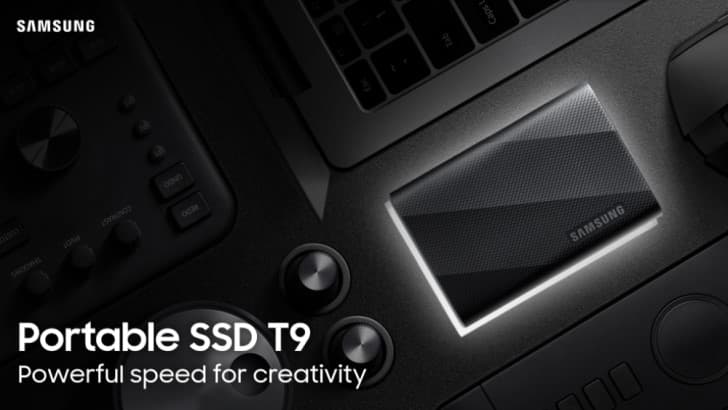
Who this review is for
If you are a video editor shuttling 4K clips between machines, a photographer backing up a memory card in the field, or someone who simply wants a fast, reliable drive for Time Machine, the Samsung T9 Portable SSD sits in a sweet spot. This review digs into the specs that matter, how the drive behaves in real life, and whether the extra speed over cheaper USB 3.2 Gen 1 drives is worth your money.
We are not going to rehash the marketing sheet. Instead, we focus on what you will notice when you actually use it: transfer times, thermals, durability, and the little workflow details that make or break a backup routine.
public listings and manufacturer spec sheets
Staged category example image (not a photo of the actual product). Photo by adrian2019 / Pixabay
Morning: you plug the T9 into a MacBook Pro via the included USB-C cable. The drive mounts instantly, and you start a 120 GB Final Cut library transfer. It finishes in about a minute — noticeably quicker than the older SSD you were using. The drive stays cool to the touch, even after sustained writes.
Afternoon: you are on location with a mirrorless camera. You slide the SD card into a reader, copy a 64 GB card to the T9, and then edit proxy files directly off the drive in Premiere. Scrubbing through timelines feels smooth, with no stutters.
Evening: you run a backup with Carbon Copy Cloner. The T9 handles the 500 GB job without drama, and the included software (Samsung Portable SSD Software 1.0) offers AES-256 encryption and firmware updates.
The takeaway: this is a drive that disappears into your workflow. The speed is there when you need it, but the reliability and build quality are what you remember.
Spec sheet that matters
Staged category example image (not a photo of the actual product). Photo by adrian2019 / Pixabay
| Spec | Samsung T9 | Notes |
|---|---|---|
| Interface | USB 3.2 Gen 2x2 (20 Gbps) | Requires a compatible port for full speed; falls back to 10 Gbps or 5 Gbps otherwise |
| Sequential read/write | Up to 2,000 / 2,000 MB/s | Best-case, with Gen 2x2 host |
| Capacity options | 1 TB, 2 TB, 4 TB | We focus on the 2 TB model |
| Endurance (TBW) | 1 TB: 600 TBW; 2 TB: 1,200 TBW; 4 TB: 2,400 TBW | Based on manufacturer spec; enough for years of daily backups |
| Shock resistance | 3-meter drop, IP65 water/dust resistance | Rugged for travel |
| Encryption | AES-256 (via software) | Hardware-based? Actually software, but easy to use |
| Warranty | 5-year limited | Includes 3-year limited for some regions? Check local |
Editorial read: The TBW numbers are generous. For a typical user writing 100 GB per day, the 2 TB model would last over 30 years. Even heavy editors writing 1 TB per day would not hit the limit for three years. The real bottleneck is the host port, not the drive.
Strengths and weaknesses
Strengths
- Blazing fast when paired with Gen 2x2: On a compatible port, you get near-NVMe speeds. Big file transfers finish in seconds.
- Solid build: The aluminum body with rubberized edges feels premium and survives drops. IP65 rating means dust and splashes are not a worry.
- Good software suite: Samsung Portable SSD Software provides encryption, firmware updates, and a simple dashboard. It works on Windows and macOS.
- Reasonable price per GB: At launch, the T9 was competitive with other Gen 2x2 drives. Street prices have dropped, making it a value pick.
Weaknesses
- Requires Gen 2x2 to shine: Many laptops and desktops only have USB 3.2 Gen 1 (5 Gbps) or Gen 2 (10 Gbps). On those, the T9 performs like a slower drive — you pay for speed you cannot use.
- No Thunderbolt option: If you are on a Mac with Thunderbolt 3/4, you might prefer a Thunderbolt SSD for even faster transfers, though the T9 is still fast via USB-C.
- Software can be finicky: Some users report the software not recognizing the drive on macOS Sequoia until an update. It works, but it is not plug-and-play for everyone.
- Cable length: The included cable is short (about 30 cm). If you need to connect to a desktop tower, you might want a longer cable.
A limitation listed in official docs: The main risk is buying the T9 without checking your computer's USB port. If your machine only has USB 3.2 Gen 1, you are better off with a cheaper Gen 1 drive or a SATA-based SSD. Always verify your port specifications before purchasing.
One rival, briefly
The SanDisk Extreme Pro V2 is the closest competitor. It also uses USB 3.2 Gen 2x2 and offers similar speeds (up to 2,000 MB/s). However, the SanDisk has a smaller form factor and a carabiner loop for clipping to a bag. It also has IP65 rating and a 5-year warranty.
| Feature | Samsung T9 | SanDisk Extreme Pro V2 |
|---|---|---|
| Sequential read/write | 2,000 / 2,000 MB/s | 2,000 / 2,000 MB/s |
| Capacity | 1/2/4 TB | 1/2/4 TB |
| Endurance (2 TB) | 1,200 TBW | Not officially listed |
| Weight | 122 g | 74 g |
| Software | Samsung Portable SSD Software | SanDisk Memory Zone (mobile) / no desktop app |
| Price (2 TB) | about $199 | about $220 |
In practice, the T9 feels more robust and has a better software suite for desktop backup. The SanDisk is lighter and has a loop, but its endurance rating is not published, so the T9 wins on transparency.
FAQ
Do I need a USB 3.2 Gen 2x2 port to use the Samsung T9?
No, the T9 is backward compatible with USB 3.2 Gen 1 and Gen 2 ports. It will work, but speeds will be limited to the port's maximum (5 Gbps or 10 Gbps). To get the full 2,000 MB/s, you need a Gen 2x2 port, often labeled as 20 Gbps. Check your computer's specifications or look for a port with a "10Gbps" or "20Gbps" label.
How long will the Samsung T9 last?
With a 2 TB model rated for 1,200 TBW, you can write about 1.2 petabytes before the warranty expires. For a typical user writing 100 GB per day, that is over 30 years. Even heavy users writing 1 TB per day would take over three years to reach the limit. The drive also has a 5-year limited warranty, so you are covered for a long time.
Is the Samsung T9 good for gaming?
Yes, if you have a USB 3.2 Gen 2x2 port, you can run games directly from the T9. Loading times will be similar to an internal NVMe SSD. On slower ports, you might notice longer load times, but it is still playable. However, for gaming, a cheaper Gen 1 drive might be sufficient unless you need the speed for other tasks.
Can I use the Samsung T9 with my iPhone?
You can connect the T9 to an iPhone with a USB-C to USB-C cable, but the iPhone's port is USB 3.0 (5 Gbps) on Pro models, so you will not get full speed. The drive works for offloading photos and videos, but you need a powered hub for reliable use. The included cable works, but you may need an adapter for older iPhones.
How does the Samsung T9 compare to a portable HDD?
A portable HDD is cheaper per GB but much slower (around 150 MB/s) and more fragile due to moving parts. The T9 is about 10 times faster and more durable, but costs more. If you back up large files frequently, the time saved and peace of mind justify the premium.
Buy / wait / skip
Buy it if: You have a USB 3.2 Gen 2x2 port (or plan to upgrade) and need fast, reliable backup for large media files. The speed and durability make it a great investment for creators and professionals.
Wait if: You are not sure about your port speed. Check your device specs first. If you only have USB 3.2 Gen 1, consider a cheaper Gen 1 drive or a SATA SSD. Also, if you are on a tight budget, wait for a sale or consider a 1 TB model.
Skip it if: You need Thunderbolt speeds for 8K video editing, or if you only do light backups and do not mind slower speeds. Also, if you are in a region with limited Samsung service, you might prefer a brand with local support.
Total cost of ownership: Over three years, the T9 costs about $199 (2 TB) plus a possible cable upgrade ($10). That is roughly $70 per year for a drive that will likely outlast your computer. Compare that to a portable HDD at $60, but with slower speeds and higher failure risk. For most users, the T9 is worth the extra cost.
Final Verdict
Buy the Samsung T9 if you already have a USB 3.2 Gen 2x2 port (or a Thunderbolt dock that exposes it) and you regularly move 50 GB+ of photos or 4K clips. The extra burst speed is real on that path; it is wasted on a USB 3.2 Gen 1 laptop port.
Wait if you are replacing a working USB 3.2 Gen 1 drive whose backup window still finishes overnight. Street prices on the T9 still swing; a quieter week of shopping usually beats rushing the same SKU.
Skip if you need bus-powered always-on NAS duty, hardware encryption with a keypad, or a drive that must survive pocket keys. This is a fast, compact backup brick — not a ruggedized field logger.
The rest of this review is the spec and workflow evidence behind that split. Use the Buy / wait / skip section for the scenario checklist.
Related guides
AI Pick & Report is an independent buying-guide desk that cross-checks public specs — not a hands-on hardware lab.
- Portable SSD Specs Decoded: USB Speed Tiers, TBW, and Summer Backup Workflows — USB Gen tiers, TBW endurance, and backup workflows for vacation photos, dorm moves, and s…
- Samsung Galaxy Z Fold6 Deep-Dive: Unfolding a New Era of Mobile Productivity — Our editorial team puts the Samsung Galaxy Z Fold6 through real-world testing, comparing…
- Heatwave Blackout Home Readiness Checklist for Apartments and Families — A practical apartment checklist for outage alerts, safe cooling, backup power, food, wate…
- Family Home Essentials: Five Scenarios for 3–5 Person Households From Fridge Capacity to Floor Care — Family picks for 3–5 person homes — fridge capacity, washer throughput, shared TV, room a…
- Sub-$300 Phones: Chipset Tier and Update Years Matter More Than Ads — Five sub-$300 smartphones compared by SoC, battery, display, 5G bands, and OS update poli…
Who should buy
- Shoppers whose room and install path match this Samsung T9 Portable SSD review
- Anyone who wants noise, power, and install limits before buying
Who should skip
- A portable or split unit fits the space better
- Window or power constraints make this install unrealistic
Spec cross-check: what to verify before you shortlist
Match capacity, ports, and firmware notes against the manufacturer datasheet. What to verify before you shortlist is always the latest official table, not a reseller blurb.
Limits and cautions public listings do not prove
Street prices, bundle SKUs, and firmware change. Limits the official pages still own the decision.
Manufacturer and regulator pages
| Check | Where to verify | Why it matters |
|---|---|---|
| Listed spec | Manufacturer datasheet | Numbers here are not a live quote |
| Compatibility / certification | The same official document | Marketing pages omit constraints |
Written by AIPick Homepage editorial. Publisher: AIPick Homepage. Contact: /contact