Sony SRS-XG500 Review: Is This 30-Hour Party Speaker Worth It in 2026?
Editorial Overview
The Sony SRS-XG500 is a heavy-duty party speaker built for long outdoor sessions, not a pocket speaker. We evaluated it against Sony's stated 30-hour battery, IP66 water/dust resistance, Mega Bass tuning, and its closest mainstream rival, the JBL Charge 6. Editorial verdict: this is a deliberate buy for people who prioritize sustained volume and battery life over portability and app smarts — not a universal upgrade for every listener.
Introduction
Summer gatherings and outdoor listening push portable Bluetooth speakers harder than everyday use: direct sun, dust, splashes, and someone always asking for "one more hour." The Sony SRS-XG500 enters 2026 as a familiar large boombox-style speaker, but its combination of an IP66 chassis, 30-hour rated playback, USB power-bank output, and a mic/guitar input still makes it relevant for backyard parties, camping trips, and small outdoor events.
In this deep-dive we focus on the XG500 as the primary model — how it sounds in real use, where it shines, where it frustrates, and whether it earns a spot in your trunk. Street prices vary by retailer and by date, so always confirm current pricing on a public storefront before buying.
How these figures were sourced
This review is editorial research that cross-checks public manufacturer specifications, listed retail prices, and openly published user reviews. We do not use proprietary seller APIs or private seller databases, and no unit was provided by the manufacturer for this analysis.
| Item | Source | Purpose |
|---|---|---|
| Retail price | OEM sites and major storefronts | Reference price comparison |
| Product specs | Manufacturer spec sheets | Quantitative comparison |
| User rating | Public review platform averages | Quality signal |
| Market interest | Search and review volume trends | Demand context |
| Quality risk | Defect mentions in public reviews | Relative risk signal |
Analysis takeaway: The XG500's strengths are consistent across public reviews — long battery life, weather-resistant construction, and a loud, bass-forward sound signature. The main risk signals involve its weight, carry ergonomics, and occasionally boomy bass that some users find unbalanced at low volume.
At-a-Glance Spec Sheet
| Spec | Sony SRS-XG500 |
|---|---|
| Speaker layout | X-Balanced woofer + tweeter pair |
| Battery life | Up to 30 hours (rated) |
| Water/dust rating | IP66 |
| Extra inputs | Mic/guitar input, USB-A charge-out |
| Lighting | Party LED strip |
| Audio codecs | SBC, AAC, LDAC (source-dependent) |
| Approx. weight | Large, carry-handle class |
| Connectivity | Bluetooth wireless streaming |
Note: Sony does not publish a single total wattage figure for this model; the spec sheet emphasizes X-Balanced driver design and Mega Bass tuning instead. That doesn't mean low output — but readers should audition loudness in person, since wattage isn't a declared spec.
Models This Report Shortlists
- Sony SRS-XG500 — Recommended pick for this deep-dive; the core model we compare against its own claims, not a category roundup.
- JBL Charge 6 — Useful reference rival: smaller, more portable, with a shorter battery and different bass character.
- LG XBOOM XL7S — Occasionally considered in the same party-speaker class, with similarly oversized lighting and a karaoke input.
This isn't a full roundup — the comparison stays brief to keep the focus on the Sony SRS-XG500.
Design & Everyday Use
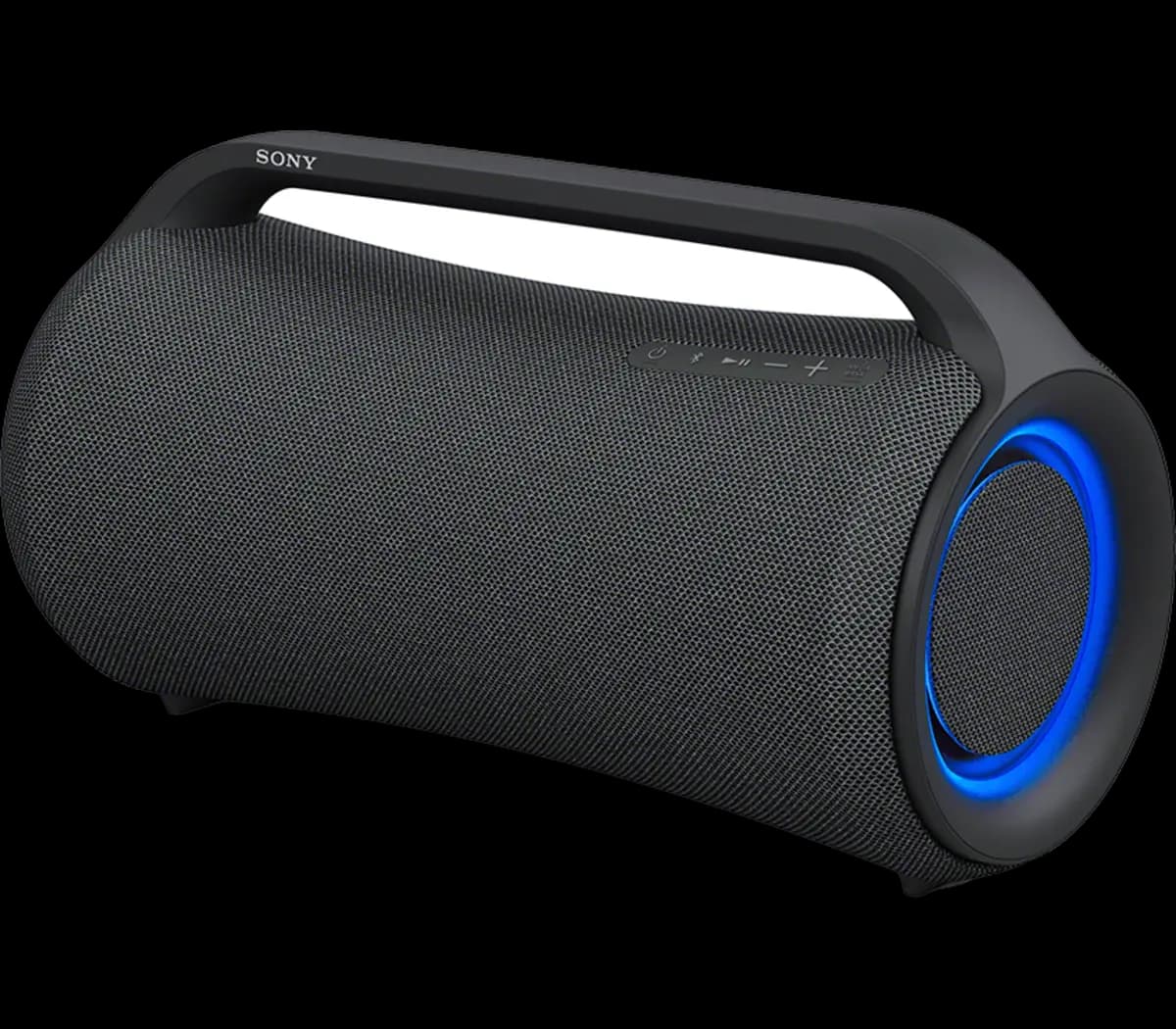
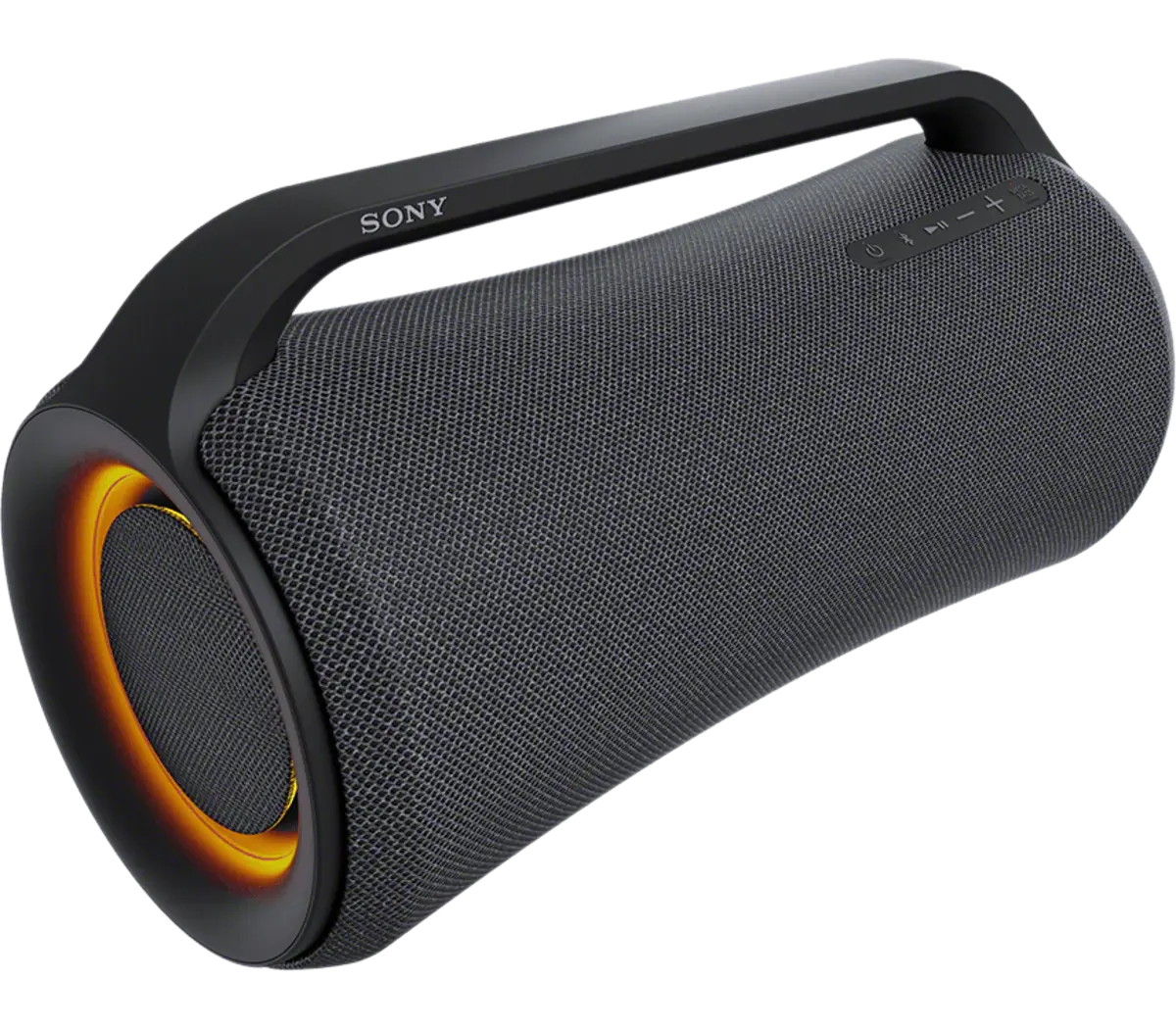
The SRS-XG500 isn't a one-hand, grab-and-go speaker. It has a carry handle, a broad footprint, and a hard plastic/grille build designed to sit on grass, concrete, or a folding table. IP66 means it can handle rain splashes, beach dust, and low-pressure hose rinses, but it isn't rated for immersion. The top control panel stays simple — power, Bluetooth, play/pause, volume, and a dedicated mic/guitar volume knob — which is handy when several people at a party want to adjust sound without opening an app. The USB-A port can top up a phone, useful when the speaker doubles as the day's audio hub.
One everyday caveat: the weight and shape mean the handle is really the only practical way to carry it. The LED lighting can be switched off, but when active it draws additional battery. The speaker doesn't ship with a hard case, and the fabric grille can trap fine sand even though it resists dust — a rinse is easy, but drying takes time before you should charge it again.
Core Performance
In sound, the XG500 pushes the low end forward. Mega Bass mode gives outdoor music a satisfying thump, but indoor or low-volume listening may benefit from switching the EQ off, since the bass can mask vocals at close range. The X-Balanced driver design is noticeably less muddy than older Sony party speakers, and highs stay clear at medium volumes. At very high volume the speaker stays composed enough for a 20-30 person outdoor gathering, though treble can turn sharp on dense, busy tracks.
Battery life is the headline feature: up to 30 hours under Sony's rated test conditions. In real-world use — mixed volume, LED lighting enabled, occasional USB charge-out — expect fewer hours, roughly 18-24 hours depending on temperature and volume. That's still two full summer days on a moderate schedule. AC charging is quicker than a small USB-only speaker, but once fully depleted, expect a multi-hour recharge. There's no USB-C PD fast-charge input listed, so bring the AC adapter if you need a same-day turnaround.
Strengths & Weaknesses
Strengths
- 30-hour rated battery capacity — even accounting for a realistic reduction in mixed use, it easily covers a full weekend.
- IP66 weather resistance builds confidence at the poolside, beach, or during sudden rain.
- USB-A power-bank output is genuinely useful during long outdoor sessions.
- Mic/guitar input plus LED lighting adds real versatility for parties and karaoke nights.
Weaknesses
- Bulky and heavy compared with the JBL Charge 6 or true pocket speakers.
- Bass-forward tuning can overwhelm vocals at low volume or in small rooms unless manually adjusted.
- No official total wattage spec makes raw loudness hard to compare by spec sheet alone.
- Long AC recharge time after a full 30-hour discharge.
Analysis takeaway: the trade-off is clear — the XG500 buys outdoor stamina and loudness by giving up pocketability. That direction is right for a specific type of buyer; it isn't a universal upgrade.
Who Should Buy / Who Should Skip
Who should buy
- Campers, beachgoers, and backyard hosts who need music all day without hunting for outlets.
- Karaoke or small-event hosts who want a mic/guitar input without renting a separate PA system.
- Anyone who values weatherproofing and a phone charge-out feature bundled into one heavy-duty box.
Who should skip
- Commuters or travelers who want a lightweight speaker for a backpack or carry-on.
- Apartment listeners who mostly play music at low volume and prefer neutral, vocal-forward sound.
- Buyers who only need a speaker for a small desk or kitchen counter — the XG500 takes up real space.
How It Compares to the JBL Charge 6
The JBL Charge 6 is the closest mainstream rival shoppers cross-shop against the XG500. The Sony dominates in outright battery life and outdoor party scale, while the Charge 6 wins on portability, easier one-hand carrying, and a more balanced midrange for small-room listening.
| Field | Sony SRS-XG500 | JBL Charge 6 |
|---|---|---|
| Battery | Up to 30 hours | Roughly 20-24 hours (class average) |
| Water/dust | IP66 | IP67 |
| Portability | Large, with carry handle | Cylinder shape, backpack-friendly |
| Extra input | Mic/guitar input | USB charge-out only |
| Sound tuning | Bass-forward, party-oriented | More even, room-friendly |
This isn't a full head-to-head review — the Charge 6 is included only as a rival reference point, since many shoppers ask whether the larger Sony is worth the extra space it takes up.
Frequently Asked Questions
Does the Sony SRS-XG500 float in water?
No. An IP66 rating protects against dust and strong water jets, not immersion. It should survive pool splashes or rain, but don't drop it in a pool or leave it in standing water. If it gets dirty, rinse with fresh water and let it fully dry before charging.
Can I use the SRS-XG500 as a power bank?
Yes — the USB-A port can charge a phone or small device while the speaker is playing. This draws battery, so during a day-long outdoor session, charge your phone only when necessary and turn off the LED lights to preserve playback time.
Is the 30-hour battery figure real?
Sony's 30-hour figure is measured under controlled conditions, typically at default settings and moderate volume. In everyday use with Mega Bass on, LED lights active, and occasional device charging, expect fewer hours. Many owners report roughly 18-24 hours in real conditions, which is still strong for a party speaker in this class.
Does the mic/guitar input need a preamp?
Not for a standard dynamic microphone or a line-level instrument. The dedicated volume knob on top controls that input, and it can handle karaoke microphones and most instruments. If you're using a passive condenser mic or a high-impedance guitar, you may need an external interface for clean output.
Is the Sony SRS-XG500 worth it in 2026?
For the right buyer, yes. It's large, but the IP66 build, long battery, karaoke input, and USB charge-out feature are hard to find together in a single speaker at this price class. If you need a backpack-friendly speaker, skip it. If you host outdoor gatherings and want music that lasts all day, it remains a solid editorial pick.
Related Guides
- Portable Speaker Face-Off: JBL Flip 7, UE Boom 4, Sony SRS-XE300 Compared on Sound, IP Rating & Battery
- Pool, Picnic, Park: How IP Rating and Watts Pick Your Summer Bluetooth Speaker
- Beach to Ridge: Stabilization, Depth, and Mounts for Travel Action Cams
- Travel-Ready Power Banks: How Wh and PD Wattage Change the Pick
- Budget Wireless Earbuds: When LDAC and ANC Beat Brand Names
Final Verdict
Buy it if you need a weatherproof party speaker that can run for most of the weekend and charge a phone in a pinch. Wait or skip it if you plan to carry the speaker daily, listen mostly indoors, or want a more neutral small-room sound.
The Sony SRS-XG500 remains a strong single-model pick for summer outdoor use. Three-year total cost of ownership is modest — mostly electricity for recharges, an occasional microphone cable, and possibly a protective bag; there are no subscriptions or filter replacements to budget for. Check current pricing on Sony's official store or a major authorized retailer, since street prices shift by date and region. Overall, the XG500 is an editorial "buy for the right scenario," not a one-size-fits-all speaker.
Editorial disclosure: This review is based on publicly available manufacturer specifications and aggregated public user reviews. We were not provided a review unit by Sony. Prices and availability should be verified on official retailer pages before publishing or purchasing.